Aeration vs Overseeding: What Does Your Atlanta Commercial Lawn Need This Fall?
An Atlanta commercial lawn can look thin, stressed, or uneven for several different reasons. Compacted clay may be limiting root growth. Summer heat may have reduced Tall Fescue coverage. Repeated foot traffic may have worn paths through an otherwise healthy stand. Those problems can look similar from a distance, but they do not call for the same treatment.
The practical answer to
aeration vs overseeding is straightforward: aeration addresses the soil, while overseeding addresses grass density. A property may need one, both, or neither. For property managers, HOA boards, and facility teams, the right fall lawn care plan starts with turf species, soil condition, coverage, drainage, irrigation, and use.
Why Fall Creates a Different Decision for Atlanta Turf
The transition from September into October gives cool-season Tall Fescue a useful establishment period as air and soil temperatures moderate. It is also when summer damage becomes easier to evaluate. Thin areas, hard soil, worn entrances, and irrigation inconsistencies are often more visible once the hottest weather has passed.
That does not make fall the correct aeration window for every lawn. Turf type comes first. YardSmith's commercial lawn aeration guidance places Tall Fescue aeration and overseeding in late summer to early fall, while warm-season Bermuda, Zoysia, and Centipede are generally aerated in late spring or early summer when actively growing. The University of Georgia's turf-type Tall Fescue calendar likewise bases aeration on active growth and identifies species-specific windows for seeding and interseeding.
This is why a shaded Tall Fescue lawn at an Atlanta office campus may need a different plan from a sunny Bermuda common area in Alpharetta. Compacted gathering spaces in Marietta may need aeration, while a lightly used Woodstock entrance with good soil but sparse coverage may benefit more from seed.
The calendar creates an opportunity, but site conditions determine the work.
Aeration vs Overseeding: What Is the Difference?
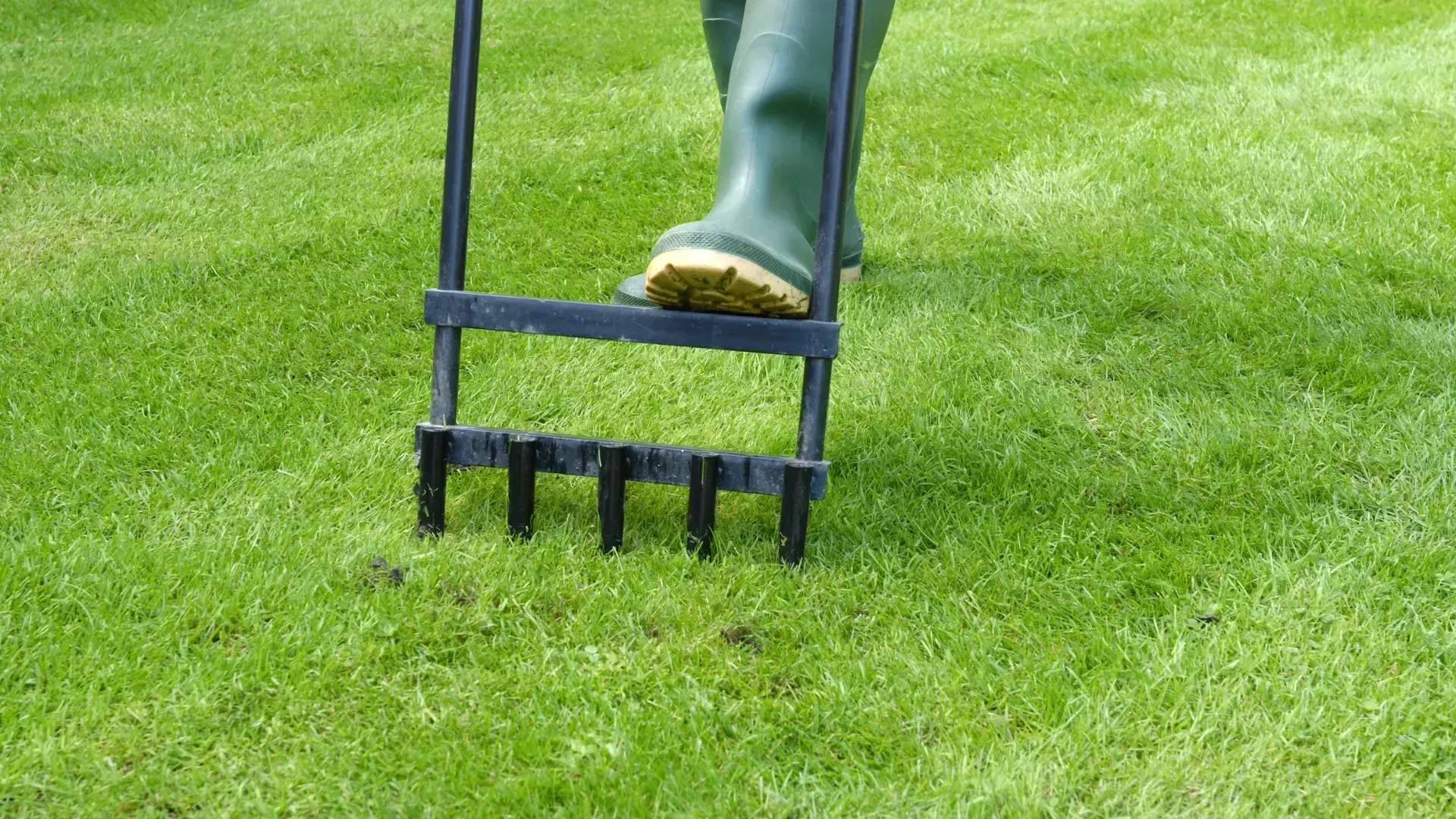
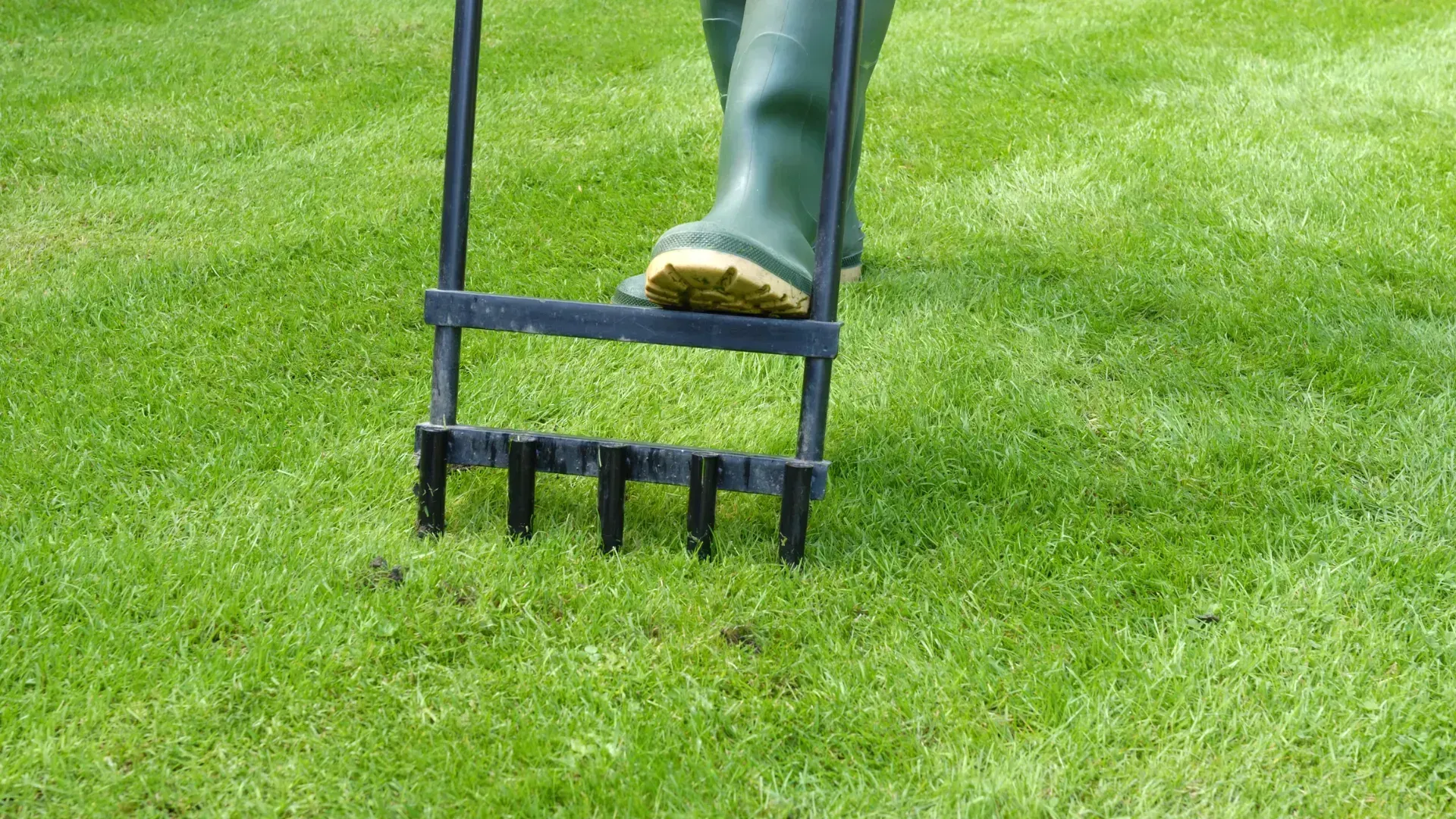
Core aeration and overseeding are complementary, not interchangeable. Core aeration removes small plugs of soil and thatch. The openings improve movement of air, water, and nutrients into the root zone while reducing resistance to roots.
Overseeding distributes seed into an existing lawn to increase density and restore thin areas. It does not loosen compacted soil. Results depend on suitable seed, seed-to-soil contact, moisture, and establishment time.
| Decision point | Core aeration | Lawn overseeding |
|---|---|---|
| Primary problem addressed | Compacted lawn soil and restricted root-zone movement | Thin turf, bare areas, and lost plant density |
| What the service adds | Pore space through removed soil cores | New grass plants through seed |
| Best evidence it is needed | Hard soil, runoff, shallow rooting, heavy traffic, poor infiltration | Visible thinning, worn patches, heat loss, weak recovery |
| What it cannot do alone | Add new grass plants to bare ground | Mechanically relieve compaction |
| Typical fall fit in Atlanta | Often appropriate for actively growing Tall Fescue | Often appropriate for thin or damaged Tall Fescue |
| When combining makes sense | When compacted soil and thin coverage exist together | When new seed also needs better soil contact |
For a property team comparing
aeration vs overseeding, the most useful question is not, “Which service is better?” It is,
“Is the limiting factor below the turf, within the turf, or both?” That framing prevents an attractive but temporary response to an unresolved soil problem.
When Your Commercial Lawn Needs Aeration
Commercial turf carries concentrated pressure. Residents take common-area shortcuts, delivery teams follow recurring paths, and maintenance equipment travels predictable routes. Event lawns, pet areas, mail kiosks, playground edges, and entrances also receive repeated traffic. Georgia's clay-rich soils can become dense under that use, especially when crossed while wet.
The USDA Natural Resources Conservation Service's soil aeration guide explains that compaction reduces pore space and can affect infiltration, rooting depth, available water, aeration, and nutrient availability. It also identifies repeated equipment use, rainfall, and trampling as causes of compaction. Those mechanisms closely match the stresses found on busy commercial and HOA grounds.
Slow infiltration is an important clue, but it is not a diagnosis by itself. Water can remain on the surface because of compacted soil, improper grading, blocked drainage, excessive irrigation, or a combination of issues. Aeration may improve the root zone, but it will not correct a broken drain or redirect runoff from a roof or parking surface.
Persistent pooling should prompt a drainage review before turf work is treated as the whole solution.
A field inspection can compare high-traffic areas with protected turf. If a soil probe enters easily in one zone but meets strong resistance in another, compaction may be uneven rather than property-wide. Soil moisture, thatch, rooting, and runoff patterns also matter. Commercial lawn aeration should follow evidence of compaction, not just a thin appearance.
Aeration alone may be enough where the existing grass stand remains reasonably dense and healthy. Once soil plugs break down, the turf can expand into small openings without adding seed. This can be the more focused choice for a property that has good coverage but poor infiltration or shallow roots.
When Overseeding Is the Better Priority
Overseeding is the stronger priority when the soil is functional but the Tall Fescue stand has lost density. Heat stress, disease, shade changes, irrigation gaps, construction traffic, and ordinary wear can leave open spaces that established Tall Fescue does not quickly fill on its own. Adding suitable seed gives those areas new plants instead of waiting for a limited recovery.
The lawn still needs a suitable seedbed. Seed scattered onto leaves, debris, dense thatch, or hard ground may not contact soil. It also needs consistent moisture during germination. Confirm that irrigation can support establishment without creating runoff, overspray, or standing water.
NC State Extension's Tall Fescue maintenance calendar recommends overseeding thin, bare areas as weather cools, maintaining moisture in the seedbed, and aerating traffic-affected or clay soils. Although local conditions must guide the final schedule, the agronomic principle is useful in Atlanta: seed solves a density problem only when moisture, contact, and timing support germination.
Lawn overseeding alone can make sense where a soil probe shows reasonable porosity, water infiltrates normally, and the primary issue is isolated thinning. It may also be appropriate after localized disturbance when the surrounding root zone remains healthy. However, seed should not be used to conceal an active problem. If shade is too dense, drainage is failing, irrigation coverage is uneven, or foot traffic is continuous, new seedlings may decline for the same reason the old turf did.
When Aeration and Overseeding Work Best Together
Combining the services is often effective because core aeration creates openings that improve seed contact. The sequence addresses compacted soil and places new seed where density has been lost. YardSmith offers aeration and overseeding as a paired commercial turf program, with seed selection based on turf type, sun exposure, and traffic.
That pairing is valuable when both problems are actually present. It is not a reason to add seed to healthy warm-season turf or aerate soil that is already loose and well structured.
Compacted Tall Fescue With Thin Coverage
This is the clearest case for a combined program. Core aeration relieves soil resistance and creates channels, while tall fescue overseeding restores plants lost to heat and wear. Office lawns near walkways, HOA green spaces, and apartment common areas often show this combination in concentrated traffic lanes.
Coordinate the work with irrigation, mowing, debris removal, and access restrictions. Seedlings need moisture and protection from intensive traffic. Results can suffer if residents, vendors, or equipment immediately resume normal use across the treated area.
Healthy Soil With Bare or Heat-Stressed Areas
Where soil structure and infiltration are acceptable, overseeding may be sufficient. The plan can focus on seed-to-soil contact, cultivar suitability, irrigation, and temporary protection of weak zones.
It is still worth asking why the coverage declined. A sunny edge may have suffered heat stress, while a shaded section may face competition from tree roots. A strip beside pavement may receive reflected heat or deicing residue. The cause should shape the correction, even when seed is the selected service.
Warm-Season Turf Entering Dormancy
Bermuda, Zoysia, and Centipede naturally change color as they enter dormancy. That seasonal appearance does not mean the lawn has failed, and it does not automatically justify fall aeration. These grasses are generally core-aerated during active growth so they can recover from the process.
Overseeding warm-season turf for winter color is separate from renovating Tall Fescue. It can affect spring transition, maintenance, water use, and the underlying turf. Owners should confirm that year-round green color is part of the property standard before adding it.
Turf Type Should Decide the Fall Plan
Atlanta sits in a transition region where cool-season and warm-season grasses both appear on commercial properties. That makes turf identification essential. A generic “fall aeration package” can be appropriate for one lawn and poorly timed for the next property.
Tall Fescue grows actively in cooler conditions and commonly needs seed to recover density because it does not spread aggressively into large bare areas. Its fall plan may include core aeration, overseeding, or both. Bermuda and Zoysia spread differently and generally recover best when actively growing in warmer months. Centipede also has its own timing and management needs. A property-wide plan should not assume every green area contains the same grass.
Mixed properties make this especially important. A sunny amenity lawn may be Bermuda, while shaded entries use Tall Fescue. New sod may sit beside older turf. Mapping those zones before service supports better timing, seed selection, and communication.
Local conditions also vary without requiring a separate rule for each city. An Alpharetta corporate campus with wooded edges may face more shade and leaf cover. A Marietta retail property may have tight turf islands exposed to pavement heat and pedestrian shortcuts. A growing Woodstock community may need scheduling around construction access and resident use. In every case, species, sunlight, traffic, moisture, and soil condition matter more than the mailing address.
What Property Managers Should Check Before Scheduling
A site review turns aeration vs overseeding from a seasonal guess into a documented decision. Walk the grounds with a map or recent photos and compare healthy turf with problem areas. Include the landscape contractor and irrigation provider when responsibilities overlap.
- Confirm the turf species in each zone. Separate Tall Fescue from Bermuda, Zoysia, Centipede, and mixed areas before selecting a fall service.
- Test for compaction. Compare probe resistance, rooting depth, and infiltration in high-traffic and protected areas when the soil is moderately moist.
- Measure existing coverage. Note isolated bare spots, widespread thinning, worn paths, and sections that remain dense enough to recover without seed.
- Check irrigation performance. Flag heads, shallow lines, valve boxes, and utility features before aeration, then confirm that seeded zones can receive consistent moisture.
- Separate drainage from soil issues. Trace pooling and runoff patterns. Correct a drainage defect when water is arriving faster than the landscape can safely manage it.
- Review traffic and operations. Plan around events, deliveries, mowing, pets, school use, resident access, and any route that could disturb seedlings.
- Coordinate weed-control timing. Some pre-emergent and post-emergent products can interfere with establishment, so review product labels and the full treatment calendar before seeding.
The resulting scope should state which zones receive aeration, which receive seed, where both are planned, and what aftercare is required. That level of detail makes vendor proposals easier to compare and gives stakeholders a clear expectation for access, irrigation, and recovery.
What Commercial Aeration and Overseeding Cost
YardSmith does not publish a one-price-fits-all rate for commercial aeration or overseeding. We price the actual property and scope because acreage, access, turf type, slopes, obstacles, soil condition, required passes, seed, irrigation features, and scheduling can change the labor and materials involved. A measured commercial quote is more useful than applying a residential average to an office park, HOA, school, or apartment community.
Estimated 2026 Market Context
The figures below are external planning references, not YardSmith pricing or a commercial proposal. They help explain the relative scale of services, but a large or complex Atlanta property requires an inspected quote.
| Planning reference | Published market context | How to interpret it |
|---|---|---|
| Basic lawn aeration | $0.19 to $0.45 per square foot | Homewyse's May 2026 national estimate assumes basic work in readily serviceable conditions and advises using it as a discussion starting point. |
| Residential aeration | $100 to $300 average | HomeGuide's lawn aeration cost guide reports lawn size, slope, preparation, and location as price factors. |
| Residential aeration plus overseeding | $160 to $425 for 10,000 square feet | HomeGuide reports this combined-service range by grass type. It is a residential benchmark, not a commercial acreage rate. |
| YardSmith commercial scope | Property-specific quote | Turf area, access, passes, seed choice, irrigation marking, obstacles, slope, soil, and operating schedule are reviewed for the actual site. |
Price comparisons work only when scopes match. One proposal may cover core aeration alone; another may include seed, multiple passes, preparation, cleanup, or follow-up. Ask each contractor to identify treated square footage, equipment, seed type and rate, exclusions, irrigation responsibilities, and site preparation.
The lowest total is not necessarily the lowest comparable price if key work is missing.
Frequently Asked Questions
Is aeration the same as overseeding?
No. Aeration removes soil cores to address compaction and root-zone movement. Overseeding adds seed to increase density. A dense lawn on compacted soil may need aeration alone, while thin turf on sound soil may need only seed.
Does every Atlanta commercial lawn need both services in fall?
No. The correct service depends on turf species and condition. Actively growing Tall Fescue may benefit from one or both, while warm-season grasses usually follow a different aeration schedule. An inspection should identify soil compaction, existing coverage, drainage, traffic, shade, and irrigation before the scope is set.
Is Tall Fescue overseeding best after core aeration?
It often is when the soil is compacted because aeration exposes soil and creates openings that improve seed contact. If the soil is already porous and only a few areas are thin, targeted preparation and overseeding may be enough. The service should match the physical condition rather than follow an automatic bundle.
Can overseeding fix compacted lawn soil?
No. Seed may germinate at the surface, but overseeding does not mechanically reduce compaction. Restricted roots, weak infiltration, and heavy traffic can continue to limit the new turf. Where compaction is confirmed, core aeration or a broader soil strategy should address that limiting condition.
How soon can tenants or residents use the lawn after service?
Seeded areas need time, moisture, and protection during germination and early growth. The restriction depends on turf, weather, soil moisture, and use intensity. Communicate temporary routes, signs, irrigation times, and mowing plans before service.
Does YardSmith serve commercial properties outside Atlanta?
Yes. YardSmith provides commercial lawn aeration and related property services across Greater Atlanta, including Alpharetta, Marietta, and Woodstock. We work with businesses, HOAs, apartment communities, office parks, schools, parks, and municipal properties. Availability and scope are confirmed for the specific site.
Build the Fall Program Around the Turf You Have
The best decision is not aeration or overseeding by default. It is the treatment that matches the constraint. Choose aeration for documented compaction, overseeding for lost Tall Fescue density, and a combined program when both conditions exist. First resolve drainage, irrigation, shade, or traffic problems that would undermine the work, and keep warm-season turf on its appropriate growth schedule.
YardSmith has served Atlanta-area commercial properties and HOA communities since 2001. We can inspect the turf, distinguish soil issues from coverage loss, identify the right service zones, and build a quote around the property's size, access, and operating needs. Call (678) 768-1686 or book online to plan commercial lawn aeration and overseeding for your grounds.
Commercial Landscaping and Property Maintenance
Recent Posts
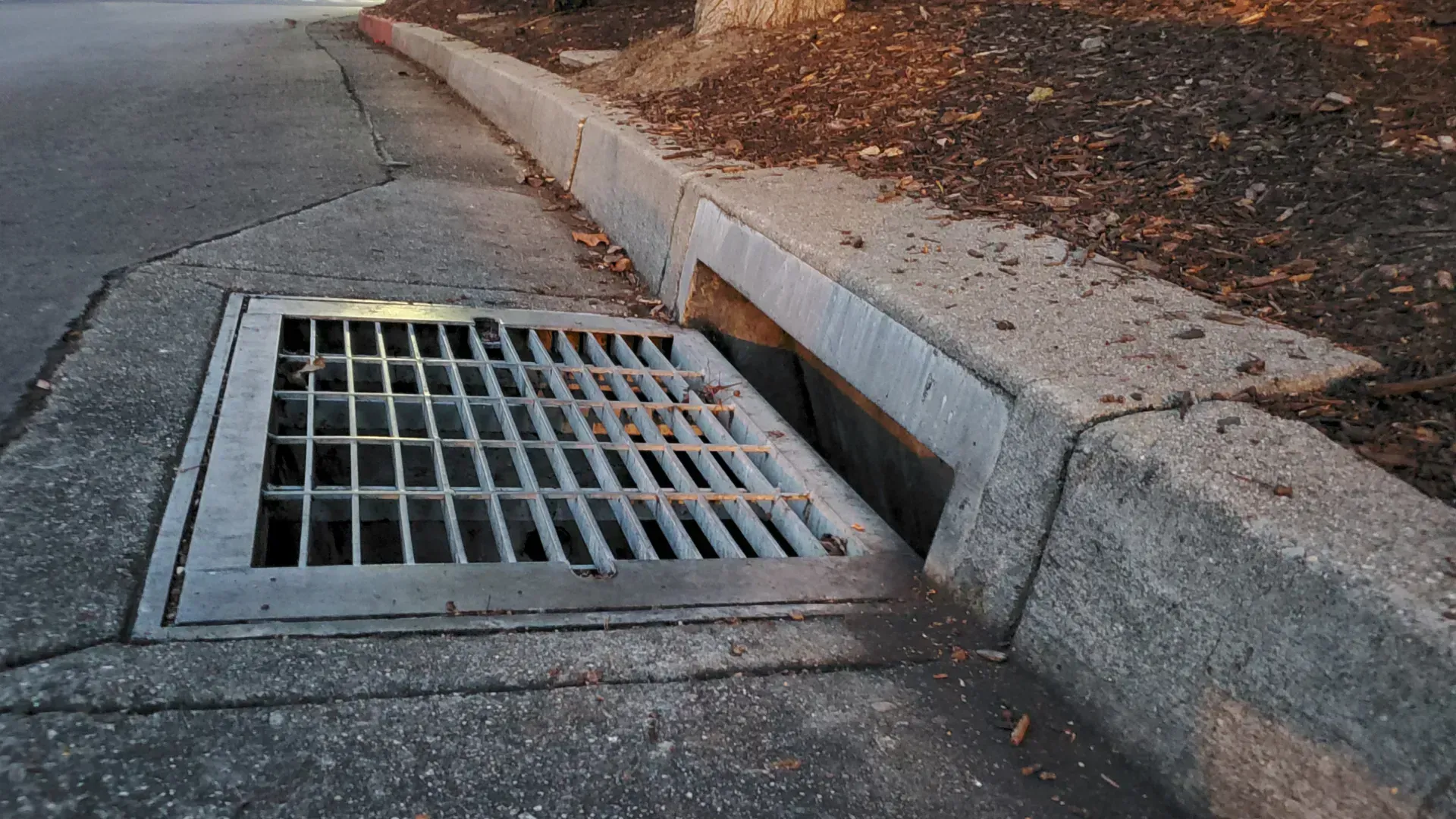
Why Georgia's Heavy Clay Soil Makes Proper Drainage a Non-Negotiable for Atlanta Homeowners and HOAs