Why Georgia's Heavy Clay Soil Makes Proper Drainage a Non-Negotiable for Atlanta Homeowners and HOAs
A commercial property manager in Alpharetta or Woodstock who is watching water pool across a parking lot after a summer storm is not looking at an inconvenience. They are looking at a liability, a foundation risk, a turf loss, and an HOA complaint waiting to happen, all at once.
That is what Georgia's clay soil and rainfall combination produces on commercial properties that do not have drainage systems designed to handle it.
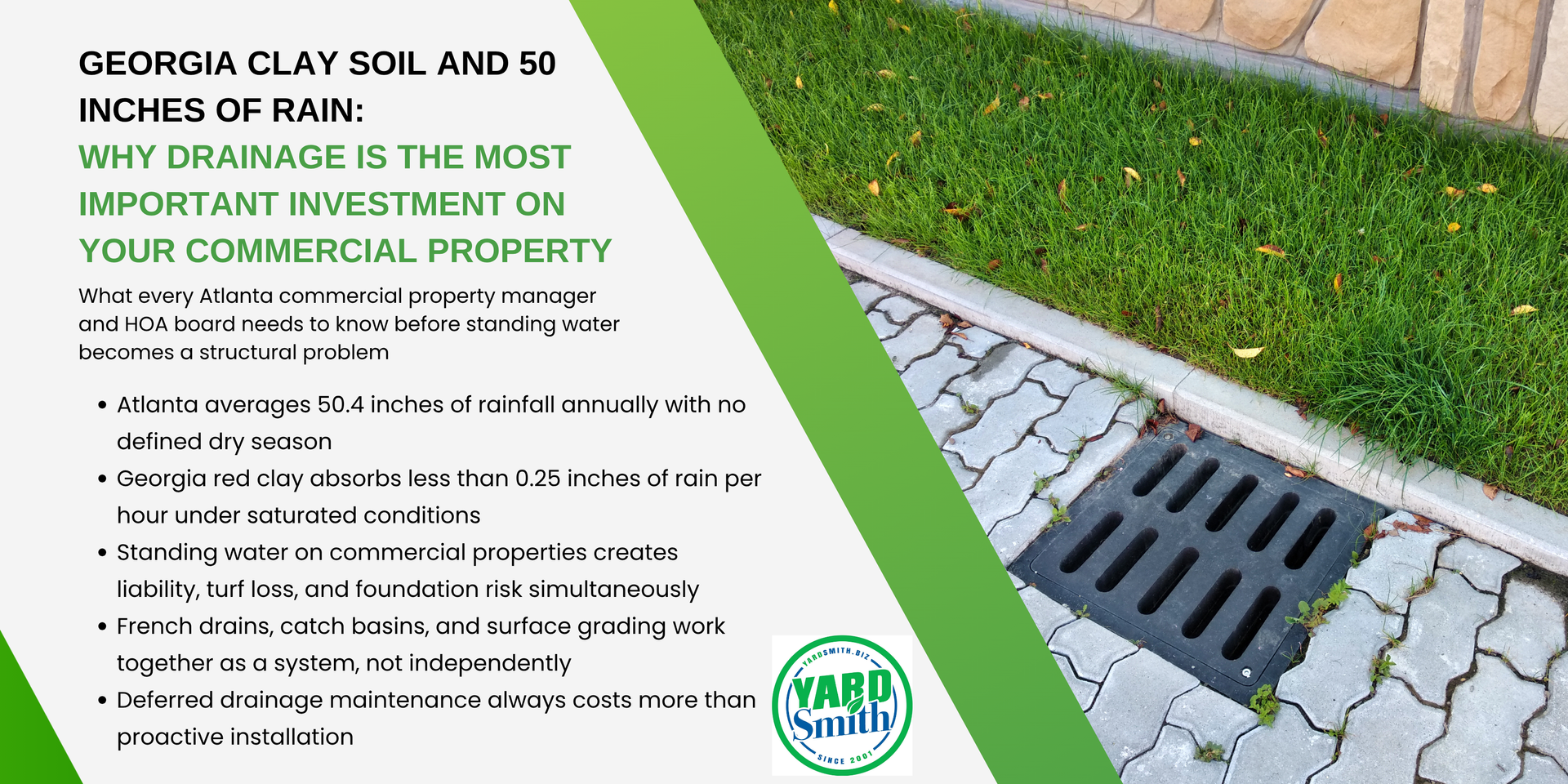
According to NOAA National Centers for Environmental Information data, Atlanta receives an average of 50.4 inches of precipitation per year across all twelve months. That is more annual rainfall than Seattle. What makes metro Atlanta's drainage challenge different from most other high-rainfall markets is not the volume of water. It is what happens to that water when it hits the ground.
Georgia red clay, the dominant soil across the Atlanta metro, the Cherokee County corridor, and the North Atlanta commercial belt including Alpharetta, Marietta, Woodstock, Roswell, and Canton, absorbs water at a rate of less than a quarter inch per hour under saturated conditions. With 50 inches of rain arriving across a calendar year that includes no meaningful dry season, the math produces one outcome consistently: standing water, drainage failures, and the cascading property damage that follows when water has nowhere to go.
YardSmith has been providing commercial drainage solutions across Greater Atlanta since 2001. This is the combination of conditions that every commercial property manager and HOA board in this market needs to understand before drainage becomes an emergency rather than a maintenance line item.
What Georgia Red Clay Actually Does to Water
Understanding why commercial drainage problems in Atlanta are so consistent and so consequential starts with the soil itself.
Georgia red clay is classified by the USDA Natural Resources Conservation Service as an Ultisol, a highly weathered soil type formed over millions of years in Georgia's humid subtropical climate. Its red coloration comes from iron oxide minerals concentrated through centuries of leaching. Its drainage characteristics come from something more fundamental: clay particles are among the smallest in the soil classification system, and they pack together with enough density to create what functions as a near-impermeable barrier at or just below the surface.
Sandy soil absorbs close to an inch of rain per hour. Georgia red clay in Cherokee County, Cobb County, Fulton County, and across the North Atlanta commercial corridor absorbs less than a quarter inch per hour under saturated conditions. In practical terms, this means that during a heavy summer thunderstorm in Alpharetta or Marietta, virtually all of the rainfall that hits a clay soil surface becomes runoff. It does not soak in. It pools, it sheets across impervious surfaces, it runs toward the lowest point on the property, and it stays there until it evaporates or finds a drainage pathway.
The USDA notes that construction on developed commercial sites compounds this problem significantly. Most commercial and HOA properties in Greater Atlanta had their topsoil completely removed during site development. Heavy construction equipment compacted the remaining clay subsoil during the building process. What is left is a surface with virtually no organic matter, maximum compaction, and the lowest possible drainage capacity for an already challenging soil type.
| Soil type | Approximate infiltration rate | What this means for a commercial property |
|---|---|---|
| Sandy soil | Up to 1 inch per hour | Water absorbs quickly, surface dries fast after rain |
| Loam soil | 0.5 to 0.75 inches per hour | Moderate drainage, some pooling in low areas |
| Georgia red clay (undeveloped) | 0.1 to 0.25 inches per hour | Most rainfall becomes surface runoff immediately |
| Georgia red clay (compacted, post-construction) | Less than 0.1 inches per hour | Nearly all rainfall pools on the surface or runs off |
Why 50 Inches of Annual Rainfall Changes the Risk Profile for Atlanta Properties
Most commercial property managers who move to the Atlanta metro from drier markets are surprised by how frequently they are dealing with standing water. The assumption before arriving is that Georgia is a warm Southern state. The reality once they are managing properties in Woodstock, Canton, or along the Alpharetta commercial corridor is that rainfall arrives in volume, distributed across all twelve months, and the clay soil underneath the property does not absorb it.
The NOAA National Weather Service Atlanta office documents Atlanta's rainfall as distributed with no significant dry season, with March as the heaviest individual month and meaningful precipitation events occurring in virtually every calendar month.
The September 2009 Atlanta flooding event, which the NWS documented as producing 10 to 20 inches of rain in under 24 hours across the metro area and causing an estimated $500 million in property damage, represents an extreme. But the combination of regular rainfall events on clay soil that cannot absorb it is an every-year reality for commercial property managers across Greater Atlanta, not a once-in-a-decade condition.
For HOA communities and commercial properties, this translates into specific recurring problems that YardSmith encounters consistently across its service area:
Parking lot flooding. Impervious concrete and asphalt parking surfaces produce instant runoff during any rain event. On properties where the surrounding soil is compacted clay with no drainage infrastructure, that runoff has nowhere to go except to pool in low areas, enter building foundations, or sheet across pedestrian pathways. This is a safety liability and a property maintenance problem simultaneously.
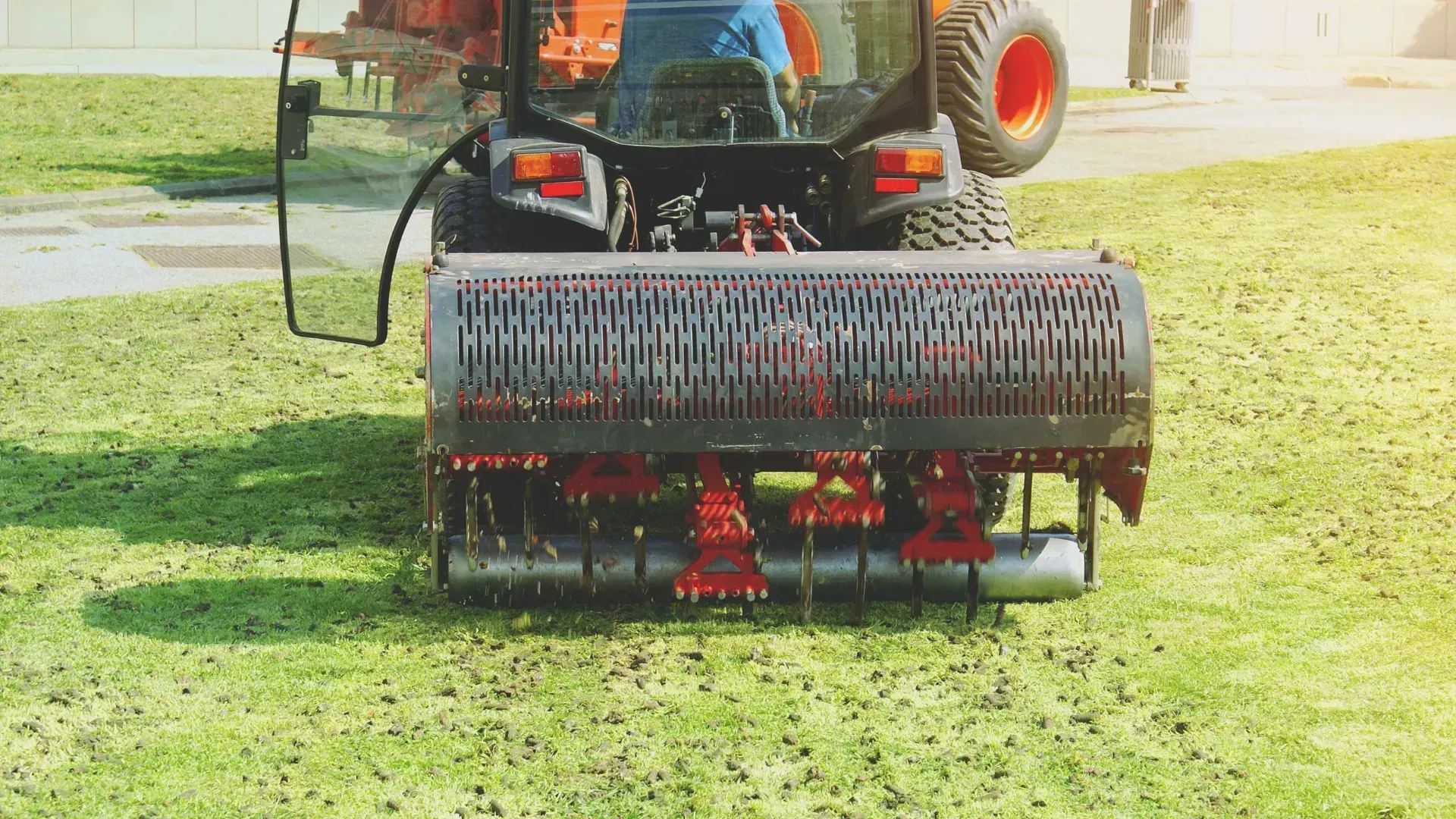
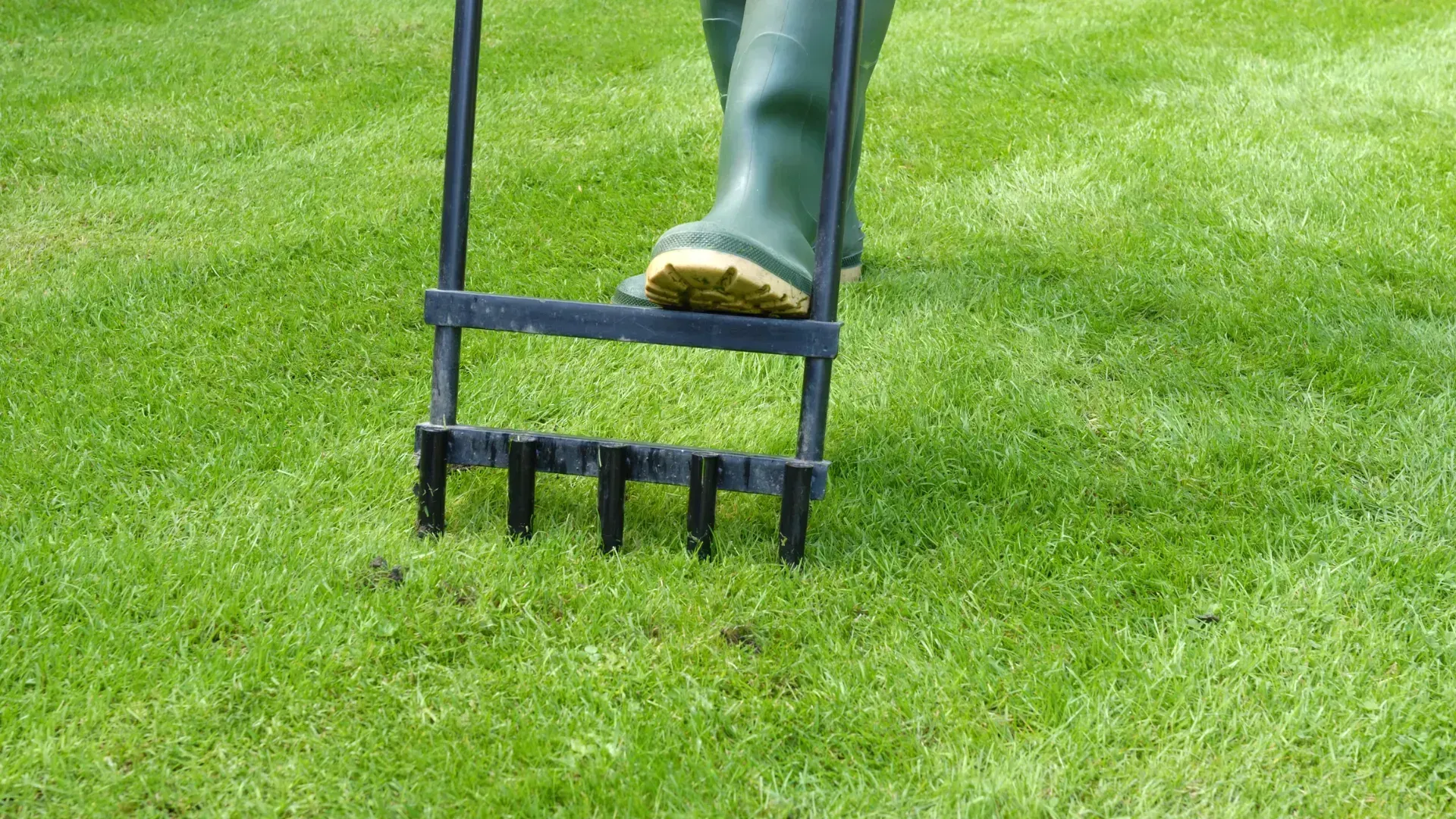
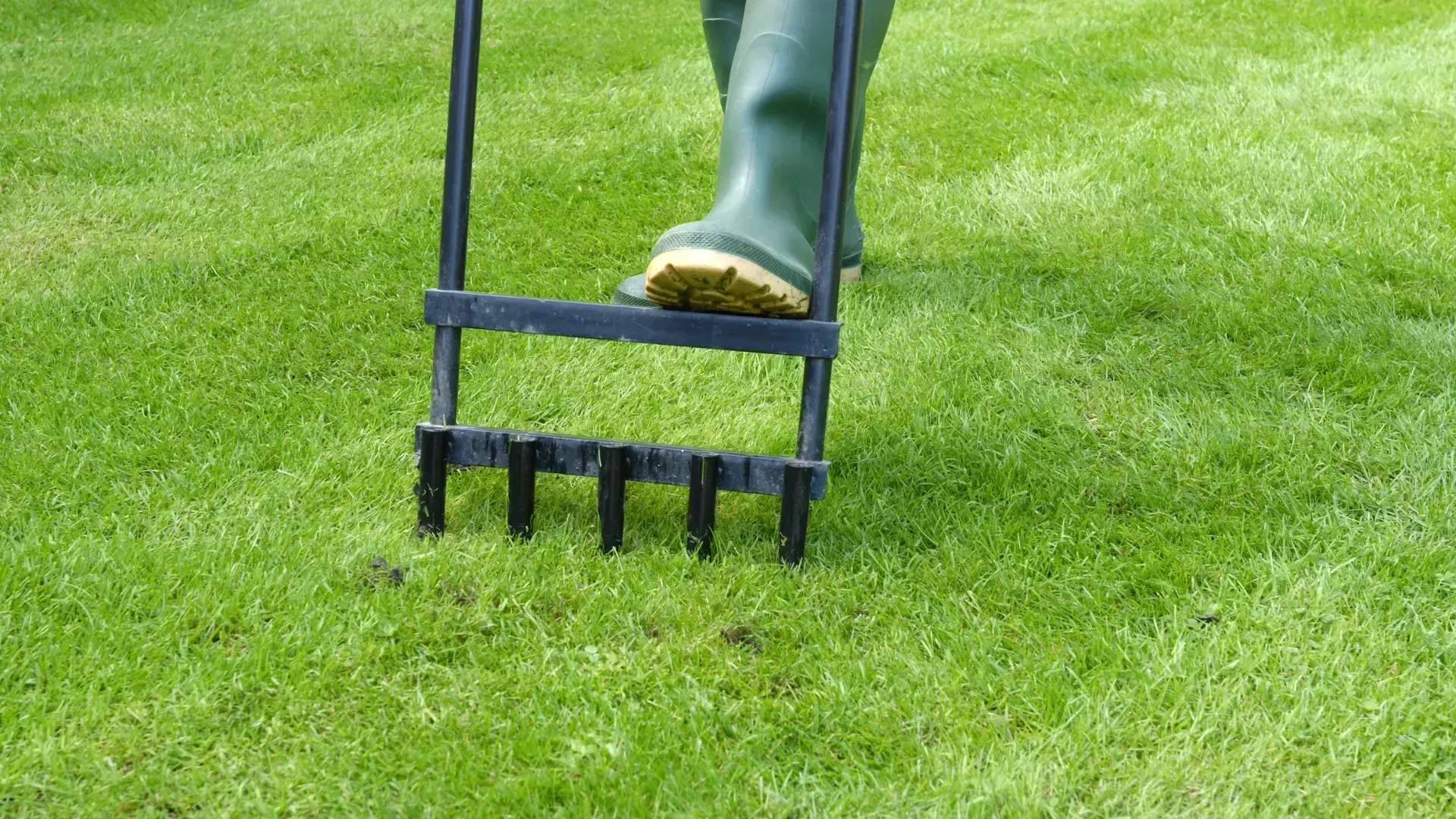
Turf failure in low areas. Commercial turf and HOA common area grass in consistently saturated zones develops root rot, bare spots, and mold. Grass that is underwater for extended periods after every rain event does not recover without addressing the underlying drainage condition. Overseeding and aeration, which are standard turf improvement tools, do not hold in areas where the soil never fully drains.
Foundation saturation near buildings. Hydrostatic pressure from consistently saturated soil against commercial building foundations and retaining walls is one of the most consequential and least visible consequences of inadequate drainage. By the time interior foundation moisture or wall movement becomes visible, the drainage failure that caused it has typically been building for multiple seasons.
HOA landscape appearance and complaint frequency. Standing water in common areas, erosion channels across landscaped slopes, and turf failure in low areas are among the most consistent sources of HOA resident complaints. For HOA boards in Woodstock, Roswell, and Canton, these are not aesthetic issues. They are property value, liability, and board accountability issues.
The Three Commercial Drainage Solutions That Address Georgia Clay Conditions
There is no single drainage solution that addresses every commercial property drainage problem in the Atlanta metro. The right approach depends on where water is entering the property, where it is collecting, and what path it needs to travel to reach an appropriate discharge point. YardSmith assesses all three variables before recommending any installation.
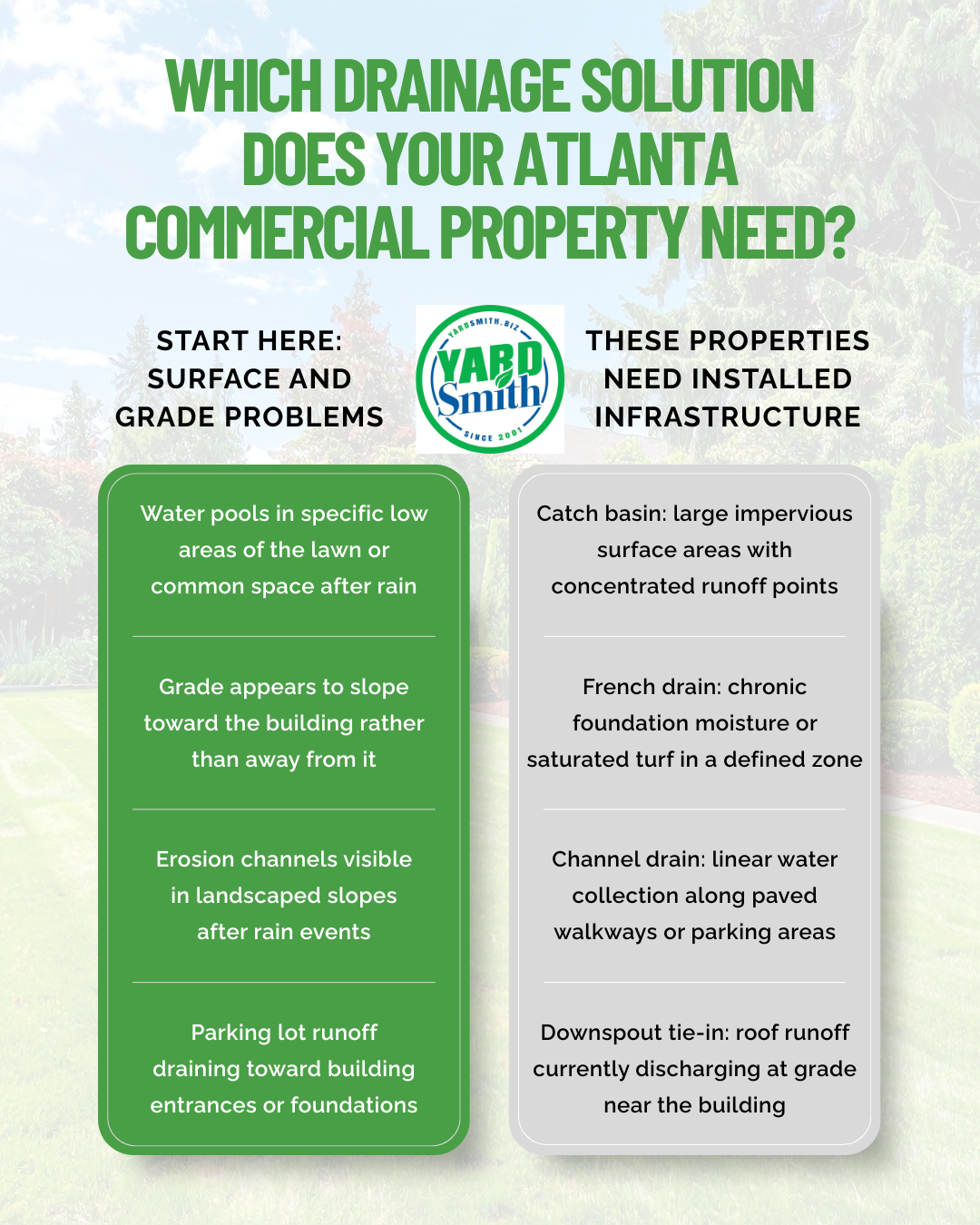
French drains. A French drain is a perforated pipe set in a gravel-filled trench that intercepts groundwater or surface water and redirects it to a discharge point away from the structure or problem area. In Georgia clay conditions, French drains are most effective when they are installed to the depth at which groundwater is traveling through the soil, and when the trench is backfilled with drainage gravel that provides infiltration capacity the surrounding clay cannot.
On commercial properties and HOA communities across Alpharetta, Marietta, and Canton with chronic foundation moisture or turf saturation in specific zones, a properly designed French drain system is the most targeted solution.
Catch basins and surface drains. A catch basin is a surface-level inlet that captures runoff from parking lots, hardscaped plazas, and landscaped areas and routes it through underground pipe to a discharge point or connection to the municipal storm system. On commercial properties with large impervious surface areas, catch basins are the primary tool for managing the volume of runoff that clay soil cannot absorb. Surface channel drains serve a similar function along paved areas where linear water collection is more practical than a point inlet.
Surface grading corrections. Many drainage problems on commercial and HOA properties in Greater Atlanta are not infrastructure failures. They are grading failures. Soil that has settled over years of freeze-thaw cycling, irrigation, and foot and vehicle traffic often reverses original grades so that water now flows toward buildings rather than away from them.
Regrading the surface to restore proper positive drainage away from structures is frequently the most cost-effective first step before any pipe system is installed.
Why Commercial Properties and HOAs Deferred Drainage Is Always More Expensive
The most consistent pattern YardSmith encounters across commercial and HOA accounts in Greater Atlanta is deferred drainage. A property manager or HOA board notices standing water. They evaluate the cost of a drainage installation and defer it to the next budget cycle. The standing water continues. The turf in the affected area fails. The foundation shows moisture. The HOA complaint volume increases. An emergency board meeting is called. The drainage project is now urgent.
The cost of that same drainage project, which was a planned installation six months ago, is now higher because the scope has expanded to include turf restoration, and in some cases foundation assessment.
The University of Georgia Cooperative Extension and USDA NRCS resources on Georgia soil management consistently identify drainage as a foundational site condition that determines the performance of every other landscape investment.
Turf, trees, shrubs, and hardscaping all perform at the level their drainage conditions allow. A commercial property that invests in regular landscape maintenance without addressing underlying drainage issues is not protecting its landscape investment. It is deferring it.
For property managers evaluating commercial maintenance programs, YardSmith's
commercial and HOA landscape maintenance service includes drainage assessment as part of the property evaluation process. Identifying drainage vulnerabilities during the maintenance relationship allows for planned, budgeted drainage solutions rather than reactive emergency installations.
Drainage as a Property Management and HOA Liability Issue
Beyond turf and foundation concerns, standing water on commercial and HOA properties in Georgia creates specific liability exposure that property managers and HOA boards need to account for.
A tenant, resident, or visitor who is injured on a flooded walkway, a slippery wet parking surface, or an unmarked standing water hazard is a premises liability issue.
Georgia property liability standards require that property owners and managers maintain safe conditions for foreseeable visitors. Standing water that is the result of an inadequate drainage system is a foreseeable, recurring condition that a property manager is in a position to correct.
FEMA and the National Flood Insurance Program document that water damage is consistently among the most expensive categories of property loss, with damage costs that expand significantly when water access to structures is not controlled.
For commercial properties and HOA communities in Greater Atlanta, the cost of a drainage installation is a fraction of the cost of the liability and property damage exposure that inadequate drainage creates.
YardSmith's drainage service covers French drain installation, catch basin installation, surface grading, downspout tie-ins, and channel drain systems across the full Greater Atlanta commercial and HOA service area. Every project begins with a free on-site assessment that identifies the drainage condition, the appropriate solution, and a written scope before any work begins.
Seasonal Drainage Maintenance for Atlanta Commercial Properties
Georgia's year-round rainfall means there is no off-season for drainage management on commercial and HOA properties. There is, however, a maintenance calendar that keeps drainage infrastructure performing through the full cycle of Atlanta's weather conditions.
| Season | Drainage maintenance priority for Atlanta commercial properties |
|---|---|
| Spring | Clear catch basin inlets and outlet pipes of winter debris; inspect French drain outlets for blockage from leaf and sediment accumulation; assess turf condition in low areas for evidence of winter saturation |
| Summer | Monitor performance during heavy thunderstorm events; identify new pooling areas that may have developed from grade settlement; assess downspout tie-in performance during peak rainfall months |
| Fall | Full catch basin cleaning before leaf season creates inlet blockage; inspect outlet pipes and discharge points for root intrusion or sediment; document any drainage failures from summer storms for planned winter improvements |
| Winter | Plan drainage improvements and installations for the coming spring before peak rainfall season; address any grading corrections identified during the prior year; review HOA budget allocations for drainage infrastructure |
For commercial property managers and HOA boards that want to address drainage as part of a comprehensive property maintenance program, YardSmith builds customized annual maintenance plans that incorporate drainage assessment, aeration to improve surface absorption, and scheduled catch basin maintenance alongside landscape and exterior property care.
Frequently Asked Questions
Why does my Atlanta commercial property have drainage problems even though it was recently developed?
New commercial developments in metro Atlanta frequently have drainage issues because site development removes topsoil and compacts the underlying clay subsoil with heavy equipment. The drainage systems installed during construction address the minimum code requirement, not the long-term performance need of the property. As parking lots settle, grades shift, and plant material establishes, drainage conditions change. Properties that did not have standing water issues in year one often develop them by year five.
What is the difference between a French drain and a catch basin?
A French drain is a perforated pipe in a gravel-filled trench that intercepts groundwater traveling through or just below the soil and redirects it to a discharge point. It is most effective for subsurface water management and chronic soil saturation. A catch basin is a surface inlet that captures runoff from above-grade areas and routes it through solid pipe to a discharge point. It is most effective for managing runoff from impervious surfaces like parking lots and plazas. Many commercial properties in Greater Atlanta need both, and YardSmith assesses which combination addresses the specific drainage failure on each property.
How do I know if my HOA community needs a drainage improvement or just better grading?
The location of the pooling and the speed at which water drains after a rain event are the primary indicators. Water that pools in a specific low area and drains within 24 hours after a moderate rain event often indicates a grading issue that can be addressed without pipe installation. Water that pools consistently, takes more than 48 hours to drain, or appears in areas adjacent to foundations or structures typically requires a French drain or catch basin system. YardSmith provides free on-site drainage assessments for HOA communities across Woodstock, Alpharetta, Marietta, Canton, and Roswell.
Can drainage improvements be included in an HOA landscape maintenance contract?
Yes. YardSmith builds drainage assessment and improvement into commercial and HOA maintenance programs. Identifying drainage vulnerabilities during the ongoing maintenance relationship allows for planned installations rather than emergency responses. HOA boards that include drainage as a line item in their annual landscape budget consistently spend less on drainage over a three to five year period than boards that address drainage reactively.
How does Georgia's clay soil affect turf performance on commercial properties?
Clay soil compacts under foot and vehicle traffic, reduces air and water movement through the root zone, and holds moisture long enough after rain events to create root stress in saturated turf. Aeration is the primary maintenance tool for improving clay soil structure, and it produces the most significant results when combined with drainage improvements that prevent chronic saturation. YardSmith's aeration service is specifically structured for the compacted clay soil conditions that commercial and HOA turf in Greater Atlanta faces.
Does YardSmith handle both drainage installation and ongoing commercial property maintenance?
Yes. YardSmith provides drainage installation, French drains, catch basins, surface grading, and downspout tie-ins alongside commercial landscape maintenance, aeration, pressure washing, fencing, outdoor lighting, and exterior property care. The single-vendor model means drainage performance is monitored as part of the ongoing maintenance relationship rather than addressed by a separate contractor who has no visibility into the rest of the property's condition.
Recent Posts